Five moves to go from growing by inertia to growing by system. The framework I have applied in every consulting engagement for more than a decade.
After fifteen years working with B2B companies of different sizes and sectors, I noticed a pattern that kept repeating: companies that hired marketing consulting almost always arrived believing they had a problem with campaigns, leads or tools. In most cases, the problem came before all of that.
The growth they had achieved up to that point was real, but fragile. It depended on the relationships of two or three key people, on a favorable sales streak, on the market growing anyway. Nobody inside the company could explain precisely why what worked was working. And for that very reason, nobody knew how to repeat it or scale it without doubling the team.
The NORTE Method was born from the need for a framework that could be applied before proposing tactics: one that starts with an honest diagnosis, continues with positioning and demand architecture, and ends with a system the team can operate on its own.
It is distilled from what has worked in more than forty engagements with B2B companies in Chile and Latin America.
Before proposing anything, I ask the questions nobody has asked inside. I skip the comfortable ones that confirm what is already known and ask the ones that make people a little uneasy, because they point to something the team was avoiding naming.
Most B2B marketing problems have a name before anyone says it out loud. The sales team knows it, but does not say it because it is not their role. The CEO senses it, but is too deep in the day to day to process it. The marketing director feels the pressure but does not have the data to articulate it.
In this first move I work with interviews, a review of historical metrics, an analysis of current customers and conversations with the sales team. The goal is clarity: one sentence that can be said out loud and that the whole team recognizes as true.
The real diagnosis is rarely what the client thinks it is. It can be a positioning problem disguised as a pricing problem. An ICP problem disguised as a conversion problem. A marketing and sales alignment problem disguised as a tooling problem. Naming the problem well is half the solution.
Fuzzy positioning is the most common and the most costly problem in B2B marketing. It is easy to understand and hard to see from the inside. When you have spent years describing your company the same way, you stop noticing that the description says nothing that sets you apart from the other ten providers in your sector.
In this move I work on three questions: who you really sell to (not who you would like to sell to), what specific problem you solve (not which services you offer) and why someone should choose you over the available alternatives. Each of the three answers has to fit in a single sentence.
Ordering the offer often means making uncomfortable decisions. Stop selling to certain segments. Be explicit about who the service is not for. Pick one angle of differentiation instead of trying to cover them all. These decisions create discomfort in the short term and clarity in the long term.
Aligning what you sell with what the market is willing to buy means redesigning the value proposition from the customer's real problems, not from the provider's own capabilities.
With positioning clear, the next move is to design the demand architecture: who we actively look for, how we find them and what has to happen for them to turn into a real conversation. In B2B this architecture is more complex than in mass consumer markets because the cycle is long, there are multiple decision makers and the perceived risk is high.
The ICP (Ideal Customer Profile) in B2B is more than a demographic segment. It combines company traits (sector, size, revenue model, maturity stage) and situational traits (moment of purchase, active problem, available budget, urgency). The most common mistake is defining the ICP too broadly because it is scary to leave money on the table.
In this move we design the demand generation architecture: which channels are most likely to reach the real ICP, which content or formats build credibility in that segment and how demand generation connects to the sales process. The pipeline does not start when the prospect raises their hand. It starts when we decide whom we want to call us.
Restructuring demand means moving from waiting for the right customers to arrive to designing the path by which they will arrive.
A company can have good strategy, good positioning and good demand channels, and still not grow predictably. The reason is usually the same: the system exists in the heads of two or three people, not in any document, process or tool the team can consult and replicate.
In this move we document the complete sales pipeline: stages, criteria for advancing, owners of each action, metrics per stage and review cadence. We keep it to the minimum needed so growth does not depend on the right people being in the right place at the right time.
The metrics we trace in this move are the three or four indicators that really predict whether the pipeline will generate revenue over the next 60 to 90 days, rather than the vanity metrics that fill dashboards. Conversion rate per stage, speed of advancement, average opportunity value, ratio of qualified opportunities to total.
Tracing the system means turning the team's tacit knowledge into operating infrastructure. So that if a key person leaves the company tomorrow, growth does not stop.
The last move is the one most underestimated by companies that have gone a long time without a system. Execution is not hard. The hard part is correcting in time when something does not work as expected. Most of the strategic mistakes I see are not errors of direction, they are errors of timing. The right decisions get made three or four months after the signals were already there.
In this move we activate the system designed in the previous moves and set the review cadence. A weekly review of operating metrics (what is happening this week), a monthly review of pipeline metrics (how the funnel is evolving) and a quarterly review of strategy metrics (whether the positioning and demand hypotheses still hold).
Fast correction means having the discipline to review the right signals at the right frequency and adjust what needs adjusting before the problem scales, instead of changing strategy every month. A channel that does not convert can be corrected in three weeks if the metrics are clear; it can cost six months and a lot of budget if the team finds out late.
Executing with fast correction is what separates a living system from a plan that gets executed and forgotten. The final goal of the NORTE Method is for the company to run this cycle on its own, without needing an outside consultant for every decision.
When we work together, you get access to a private dashboard where the NORTE process unfolds in real time. You know exactly which stage we are in, what comes next and how the health of the system is evolving.
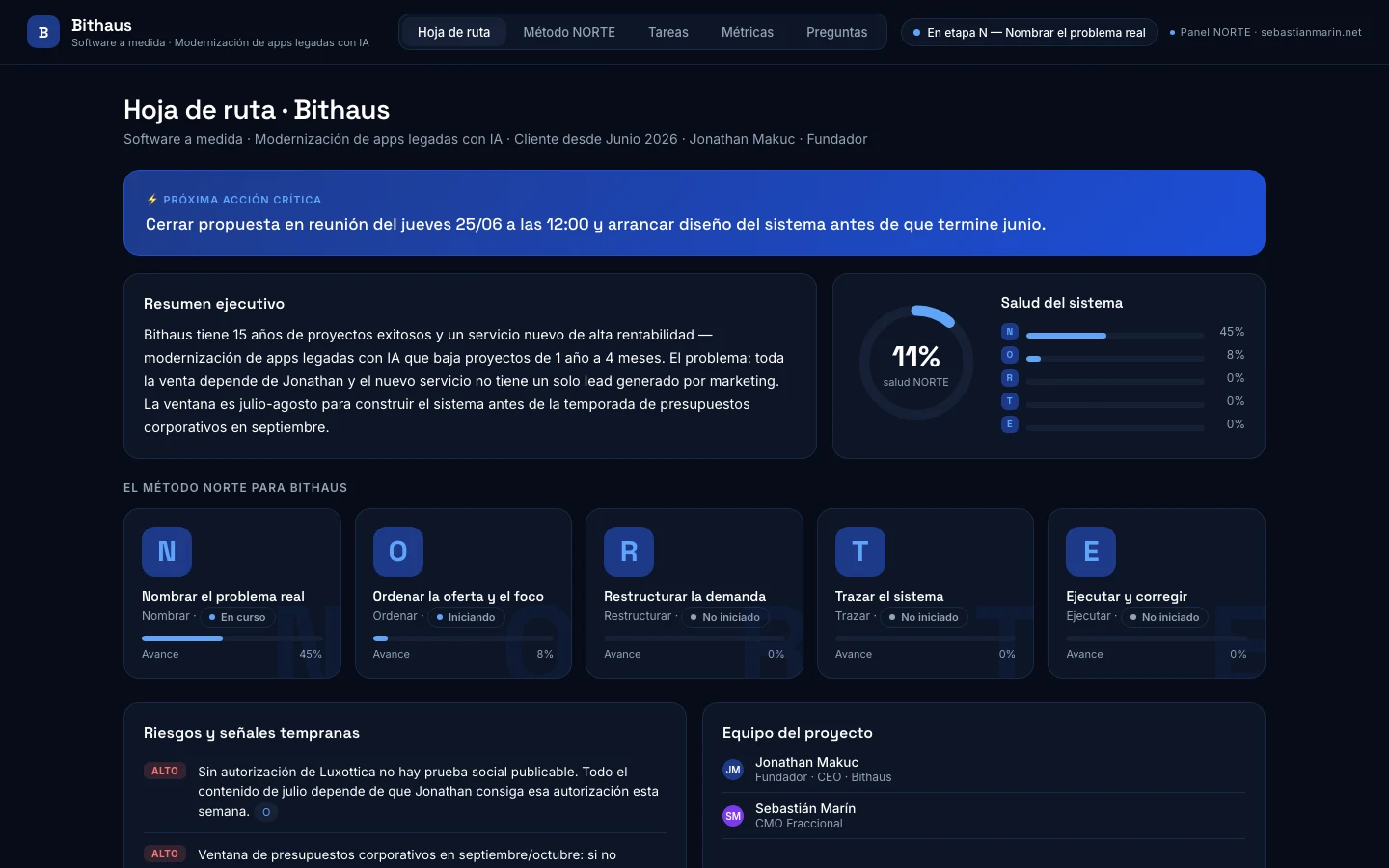
Executive summary, next critical action and health of the NORTE system. A real-time status view.
The five moves applied to your company: progress per stage, active tasks and percentage complete.
Who does what and by when. Shared visibility without depending on emails or follow-up meetings.
The indicators that predict revenue: conversion per stage, pipeline speed, quality of opportunities.
An asynchronous channel to resolve doubts without needing a meeting. I answer within 24 business hours.
Your company has customers and revenue, but growth feels disorderly. You do not really know why you win or why you lose.
The sales pipeline exists in the head of one or two people, not in any system the team can replicate.
You have doubts about whether your positioning really sets you apart or whether you sound like everyone else in your sector.
Marketing and sales work in parallel, not in coordination. The metrics one measures do not connect with what matters to the other.
You try new tactics often (social media, ads, events, content) but nothing has continuity or clear success metrics.
You are ready to commit time and resources to building a system, rather than keep looking for the one tactic that will fix everything.
From a Compass Session for one specific question, to the Fractional CMO to install the full system. The first conversation is free and lasts 15 minutes.